Scout MCP
Scout MCP is a local Model Context Protocol server that gives your coding agent direct access to the Scout OS API. Run it locally and your agent can list workflows, manage collections, trigger automations, upload files, and interact with agents — all from inside its context window, without manual API calls or copy-pasting credentials.
What is MCP?
MCP (Model Context Protocol) is an open standard that lets AI coding agents connect to external tools and services through a structured, discoverable interface. Instead of writing custom integration code for every service, you run an MCP server once and your agent immediately gains access to all the capabilities that server exposes.
In the Scout context, this means your agent can:
- Query and manage your Scout workflows, agents, and collections
- Run workflows and inspect their outputs
- Upload files to Scout Drive and sync them to tables
- Read run logs and surface failures
- Execute triggers and interact with agents in real time
Your agent treats Scout the same way it treats the filesystem or a web search — as a first-class tool it can reason about and act on.
How It Works
Scout MCP wraps the Scout OS API and exposes it as 13 domain tools. Each tool accepts an action parameter (list, get, create, update, delete) so your agent can operate on any Scout resource with a consistent interface.
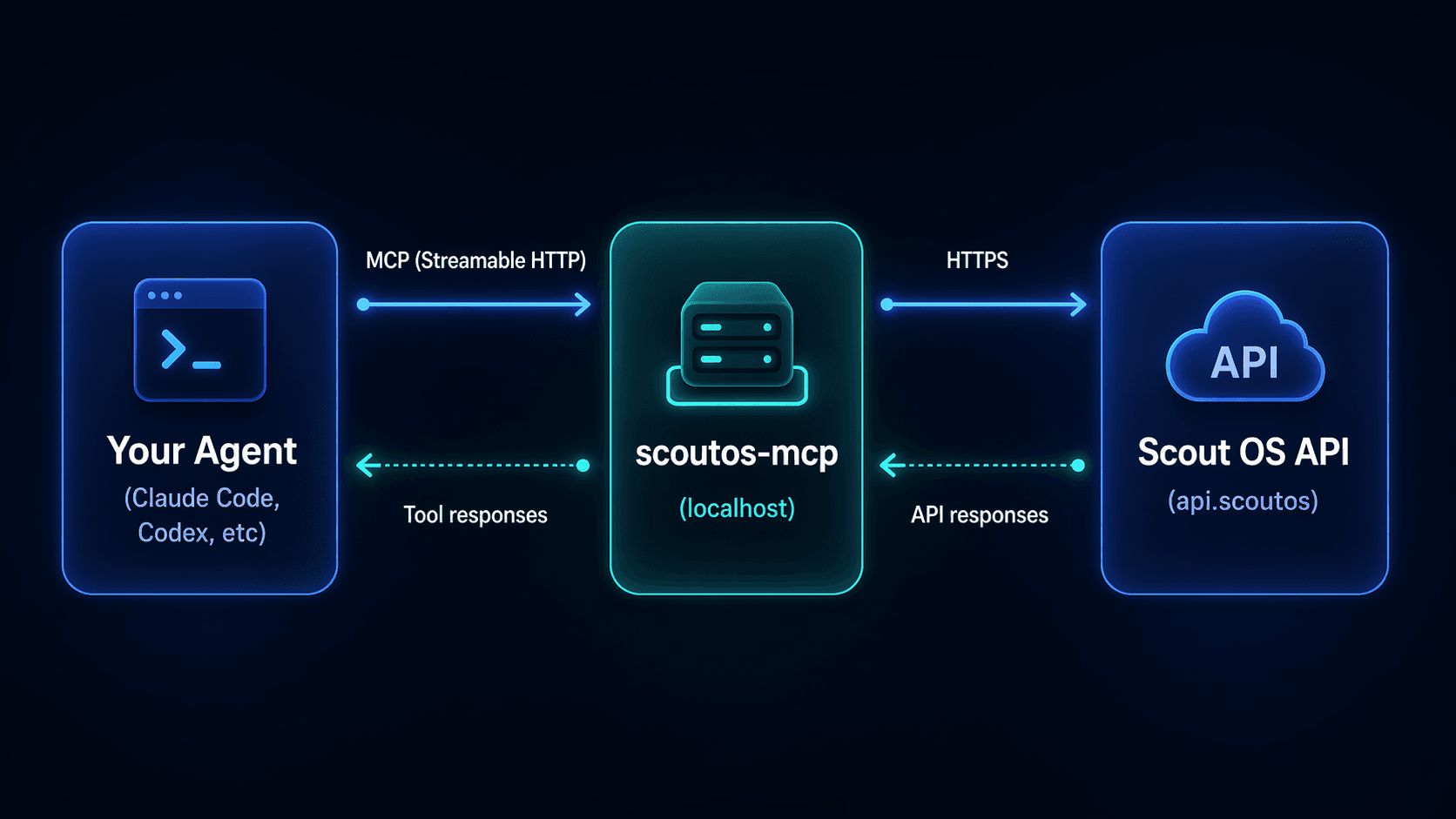
The server runs on http://127.0.0.1:9987/mcp using Streamable HTTP transport, making it compatible with any MCP-capable client.
Tool Coverage
79 Scout API endpoints are mapped to 13 domain tools:
| Tool | Covers | Actions |
|---|---|---|
scout_workflows | Workflows, revisions, environments | list, get, create, update, delete, run, run_with_config |
scout_agents | Agents | list, get, upsert, delete, interact, interact_sync |
scout_agent_sessions | Agent sessions | interact_with_session, interact_sync_with_session, interact_async_with_session |
scout_collections | Collections | list, get, create, update, delete |
scout_tables | Tables | list, get, create, update, delete, get_schema, sync |
scout_documents | Documents | list, get, create, update, update_batch, delete, delete_batch |
scout_syncs | Syncs, sources | list, get, create, update, delete, execute, list_sources |
scout_triggers | Triggers | list, create, update, delete, execute_slack, execute_telegram, execute_cron |
scout_copilots | Copilots | list, get, create, update, delete |
scout_logs | Run logs | list, get_details |
scout_integrations | Integrations, org | list, list_channels, delete_integration |
scout_drive | Drive | upload, download |
scout_usage | Usage | get |
Resources
Scout MCP also exposes read-only context resources your agent can inspect at any time:
scout://workflows— list of your workflowsscout://collections— list of your collectionsscout://agents— list of your agents
Getting Started
Prerequisites
- Node.js 18 or later
- A Scout API key — grab one from Settings → API Keys
Install and start the server
Install the package globally with npm:
npm install -g scoutos-mcpOr run it directly without installing:
npx scoutos-mcpSet your API key, then start the server:
export SCOUT_API_KEY="your_api_key_here"
scoutos-mcp
The server starts on http://127.0.0.1:9987/mcp by default. You should see output like:
Scout MCP server listening on http://127.0.0.1:9987/mcpConfirm it is healthy:
curl http://127.0.0.1:9987/healthCustomize the port or host
scoutos-mcp --port 3333 --host 127.0.0.1Run with Docker
docker build -t scoutos-mcp .
docker run -p 9987:9987 -e SCOUT_API_KEY=your_api_key_here scoutos-mcp
Restrict access with a bearer token
If you want to lock down the MCP server so only trusted clients can connect, set a bearer token before starting:
export MCP_SERVER_BEARER_TOKEN="your_secret_token"
scoutos-mcp
Clients must then include this header with every request:
Authorization: Bearer your_secret_tokenEnvironment variables
| Variable | Required | Default | Description |
|---|---|---|---|
SCOUT_API_KEY | Yes | — | Your Scout API key |
PORT | No | 9987 | Server port |
HOST | No | 127.0.0.1 | Server host |
MCP_SERVER_BEARER_TOKEN | No | — | Bearer token for client auth |
Connect Your Agent
Once the server is running, point your MCP-capable coding agent at:
http://127.0.0.1:9987/mcpEach agent configures MCP connections differently. Follow the setup guide for yours:
After connecting, your agent will discover all 13 Scout tools automatically — no additional configuration needed.
Example Usage
Here are practical examples of what you can ask your agent to do once Scout MCP is connected.
Explore your workspace
List my Scout workflows and explain what each one does.Show my collections and summarize which tables look customer-related.Find the agent named "SDR Assistant" and show its current configuration.Run and debug workflows
Run workflow <workflow-id> with this sample payload and summarize the output:
{ "company": "Acme Corp", "contact_email": "hello@acme.com" }
Check recent Scout run logs and surface any failures from today.
Show me the error details for any failed runs.Manage data
Upload this CSV to Scout Drive and then sync it to the customers table.Create a new collection called "Support Tickets" with a table that has
columns: ticket_id, status, priority, and summary.Work with triggers
List all my Scout triggers. Which ones are active?
Show me the last time each trigger fired.
Update the Slack trigger on workflow <workflow-id> to only respond
in the #support channel.Monitor usage
How much of my Scout quota have I used this month?
Break it down by workflow if possible.
Troubleshooting
| Issue | What to check |
|---|---|
| Agent cannot connect | Confirm scoutos-mcp is running and the URL matches your configured host and port |
401 or auth errors | Verify SCOUT_API_KEY is set in the environment before starting the server |
| Server starts but tools are missing | Make sure you are on the latest version: npm update -g scoutos-mcp |
| Works in one agent but not another | Confirm each agent points at http://127.0.0.1:9987/mcp and reload its MCP config |
| Health check fails | Run curl http://127.0.0.1:9987/health locally; if it fails, restart the server |
| Bearer token errors | Confirm the value of MCP_SERVER_BEARER_TOKEN and the client Authorization header match exactly |
| Port conflict on startup | Another process is using port 9987 — start with --port 3334 or another free port |